Techspire Journal of Innovation, Technology and Management
Peer-reviewed · Open access · Published by the Research Management Cell, Techspire College, Kathmandu
ISSN
3149-7640 (PRINT)
ISSN
3149-7659 (ONLINE)
Double-blind peer review
Open access
No submission or publication fee
Language: English
Call for papers — open
Inaugural Issue · Volume 1, Issue 1
Techspire College invites original research articles, review papers, case studies, and book reviews for the first issue of the journal. Submissions from faculty, research scholars, and industry practitioners are welcome.
Published issues, with authors, page ranges, and free full-text PDFs.
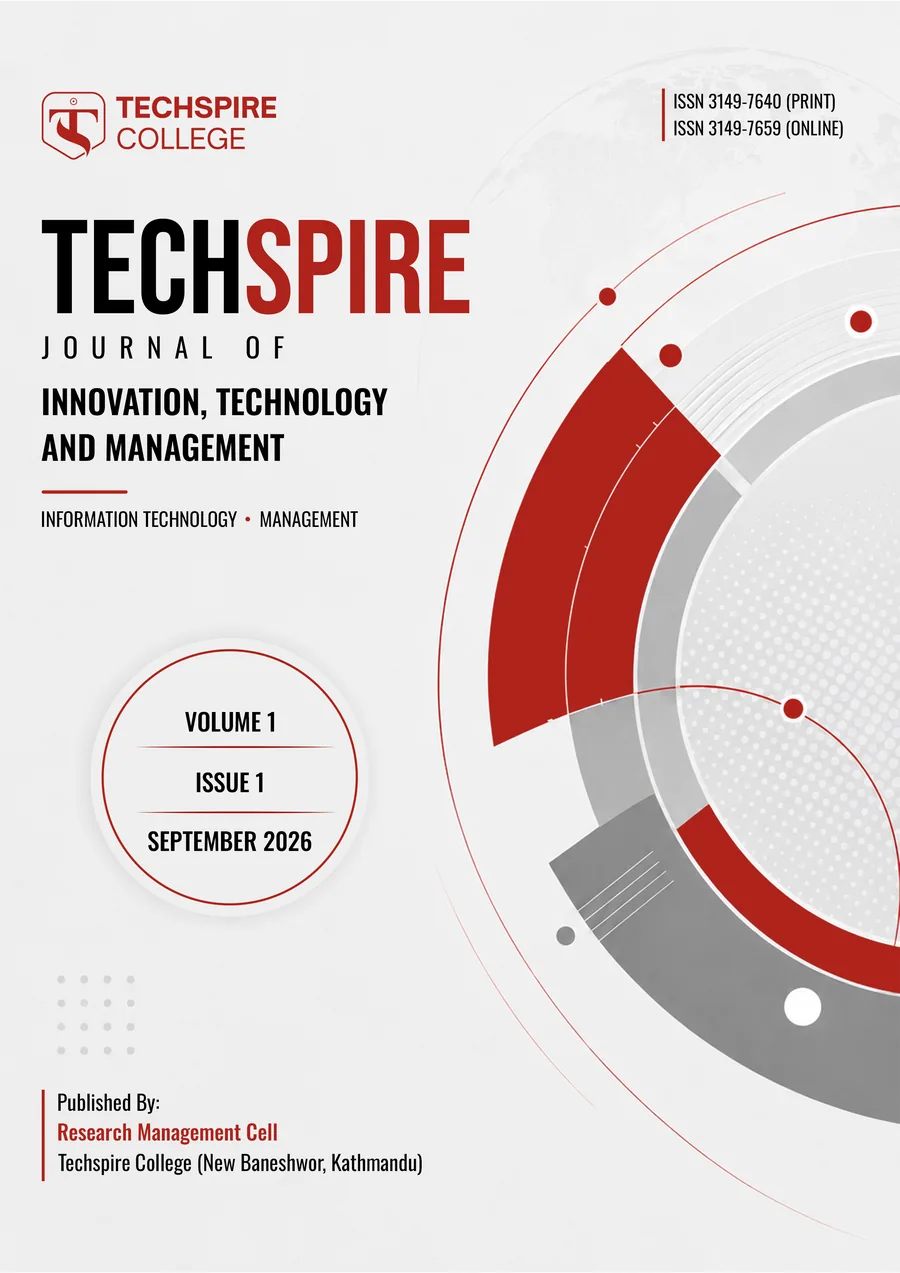
Volume 1, Issue 1
September 2026
The inaugural issue of the journal, published by the Research Management Cell, Techspire College. Six peer-reviewed research articles, 100 pages. All articles are open access under CC BY-NC-ND 4.0.
6Articles
100Pages
OpenAccess
Factors Affecting Teachers' Participation in Professional Development Activities in Kathmandu ValleyRanjana Kumari Danuwarpp. 1–21
Read PDF
Barriers to the Adoption of Agile Project Management in Nepali IT Firms: Evidence from the TOE FrameworkSmriti Duwadipp. 22–35
Read PDF
Role of Non-Governmental Organizations (NGOs) in Promoting Girls' Education in Rural NepalDeepak Raj Dawadipp. 36–50
Read PDF
Firm-Specific Factors and Equity Valuation: Evidence from Nepalese Banking StocksNischal Risal, Dhurba Lal Pandeypp. 51–67
Read PDF
Revenue Management Practices and Its Impact on Hotel Performance in NepalAbhishek Bikram Shahpp. 68–85
Read PDF
Factors Influencing Adoption of Digital Wallet in NepalPabish Thapapp. 86–100
Read PDF
About the journal
The Techspire Journal of Innovation, Technology and Management (TJITM) is an academic journal established by Techspire College to publish rigorous, original scholarship at the meeting point of computing, business, and society. It is designed to give researchers in Nepal a credible, well-edited venue for work that is often left unpublished — applied computing research, management studies grounded in local data, and evidence on how digital systems change organisations and everyday life.
The journal is open access: every published article is free to read and download, and authors retain copyright. There is no submission charge and no article processing charge. All submissions go through editorial screening followed by double-blind peer review by at least two independent reviewers.
The inaugural issue — Volume 1, Issue 1, September 2026 — is published and listed in the archive below, with a free full-text PDF for every article. The journal is registered under ISSN 3149-7640 (print) and ISSN 3149-7659 (online). Editorial board appointments will be published on this page as they are confirmed.
Focus areas
The journal publishes work in the following areas, and welcomes interdisciplinary submissions that cross them.
Innovation and Entrepreneurship
New venture creation, innovation systems, startup ecosystems, and the commercialisation of research.
Information and Communication Technology
Software and information systems, networks, data engineering, cybersecurity, and applied computing.
Operations and Supply Chain Management
Process and logistics management, procurement, service operations, and quality management.
Business Strategy and Leadership
Competitive strategy, organisational behaviour, human resources, marketing, and leadership practice.
Digital Transformation
Technology adoption in organisations, digital business models, fintech and digital payments, and e-government.
Sustainable Management and Governance
Corporate governance, ethics, social responsibility, and management for sustainable development.
Artificial Intelligence
Machine learning applications, natural language processing, decision support systems, and responsible AI.
At a glance
Review model
Double-blind
First decision
7–10 working days
Access
Open access, CC BY-NC-ND 4.0
Author fees
None
Frequency
Two issues a year (planned)
Language
English
Submission guidelines
Manuscripts must be original, unpublished, and not under consideration elsewhere. Submit by email to journal@techspire.edu.np, attaching the anonymised manuscript and a separate title page as Word documents, together with any supplementary material. No change in authorship — addition, deletion or reordering — is permitted once a manuscript has been submitted.
Manuscript format
File format
Microsoft Word (.doc or .docx). PDF files are not accepted at the submission stage.
Page setup
A4 with 1-inch (2.54 cm) margins on all sides.
Font
Times New Roman 12 pt throughout — title, headings, body text and references.
Spacing
Single-line spacing throughout.
Alignment
Left-aligned, with a ragged right edge.
Length
5,000–8,000 words, excluding references, tables, figures and appendices.
Anonymity
The manuscript file must carry no author names, affiliations or identifying information.
References
APA 7th edition for both in-text citations and the reference list.
Manuscript structure
Section
Target length
Notes
Abstract
250–300 words
A single paragraph, without subheadings.
Keywords
4–6 keywords
Placed directly after the abstract; used for indexing.
Introduction
750–1,000 words
Background, research gap, objectives and significance.
Literature review
1,500–2,000 words
Recommended, but optional at the author's discretion.
Research methodology
1,000–1,500 words
Detailed enough to allow the study to be replicated.
Results and discussion
1,500–2,000 words
May be combined or kept as two sections.
Conclusion and recommendations
300–500 words
Findings, implications, limitations and recommendations.
Title page (separate file)
Title of the manuscript — concise, descriptive, and reflecting the focus of the study.
Full names of all authors, with institutional affiliations and full addresses.
ORCID iDs for all authors, where available.
Email addresses and phone numbers for all authors.
The corresponding author's name and full contact details, including postal address.
Acknowledgment of funding sources, research assistance, and contributions not qualifying for authorship.
A conflict of interest statement covering financial and other interests.
An AI use statement naming the tools used, the purpose, and the extent of their contribution.
Pre-submission checklist
The manuscript is original, has not been published previously, and is not under consideration elsewhere.
Formatting follows the guidelines: Times New Roman 12 pt, single-spaced, A4 page, 1-inch margins.
A separate title page is included, with all author details, affiliations, contact information and disclosures.
An AI use statement is included, where applicable.
The main manuscript file is completely anonymous — no names, affiliations or identifying information.
An abstract of 250–300 words is included.
Between 4 and 6 keywords are provided.
All references follow APA 7th edition and are complete.
The paper has been screened for plagiarism and the similarity index is below 20 percent.
The manuscript has been screened for AI-generated content and the AI score is below 20 percent.
Manuscript length is within 5,000–8,000 words, excluding references and appendices.
Author downloads
The manuscript template and copyright agreement form will be published here shortly. Until then, request them from the editorial office at journal@techspire.edu.np.
Peer review process
Every manuscript follows the same route. Authors are told at each stage where their paper stands.
Submission acknowledged
Within 3 working days
The editorial office confirms receipt and assigns a manuscript number used in all correspondence.
Editorial screening
Week 1
The editor checks scope, structure, formatting, and the similarity report. Papers outside scope are returned quickly rather than held.
Double-blind review
Weeks 2–4
At least two independent reviewers assess originality, method, evidence, and contribution. Authors and reviewers remain anonymous to each other.
Editorial decision
Week 4
Accept, minor revision, major revision, or reject — issued with the full reviewer comments attached.
Revision and re-review
2 weeks for authors
Revised manuscripts are submitted with a point-by-point response, and returned to reviewers where major revision was asked for.
Copy-editing and proof
Post-acceptance
The accepted paper is copy-edited and typeset, and authors approve a final proof before publication.
Publication
Issue release
The article is published open access on this page and released as part of the issue.
Publication ethics and policies
The journal follows the principles of the Committee on Publication Ethics (COPE).
Open access and licensing
Articles are published under a Creative Commons Attribution 4.0 licence. Authors retain copyright and grant the journal the right of first publication.
Plagiarism and originality
All manuscripts are screened for similarity. Submissions above the accepted threshold, or containing undisclosed reuse of the authors' own prior work, are rejected.
Authorship
Authorship is limited to those who made a substantive contribution to the work. Changes to the author list after submission require written agreement from every listed author.
Use of generative AI
AI tools may not be listed as authors. Any use of AI in drafting, analysis, or translation must be disclosed in the manuscript, and authors remain fully responsible for the content.
Conflicts of interest and funding
Authors, reviewers, and editors must declare any financial or personal interest that could be seen to influence the work. Funding sources must be named.
Research ethics
Studies involving human participants must confirm informed consent and, where required, institutional ethical approval.
Corrections and retractions
Errors that affect the findings are addressed through a published correction or, where necessary, a retraction notice that remains permanently linked to the article.
Archiving
Published issues are archived by Techspire College and remain available on this page after release.
Editorial board
The editorial board is being constituted with academics and practitioners from Techspire College and partner institutions.
Editorial board appointments will be published here once confirmed. Academics interested in serving as an editor or reviewer are invited to write to the editorial office with a short CV.
Editorial office
Write to the editorial office for submissions, review invitations, and any question about the journal.
Techspire College, New Baneshwor-10, Kathmandu, Nepal
Founding phaseJournal name, ISSN, editorial board, and issue archive are edited from the dashboard. Keep this page unindexed until the editorial board is confirmed.
TECHSPIRE ASSISTANTHow can I help?
Hi, I can help with admissions, courses, scholarships, campus life, and contact details.